
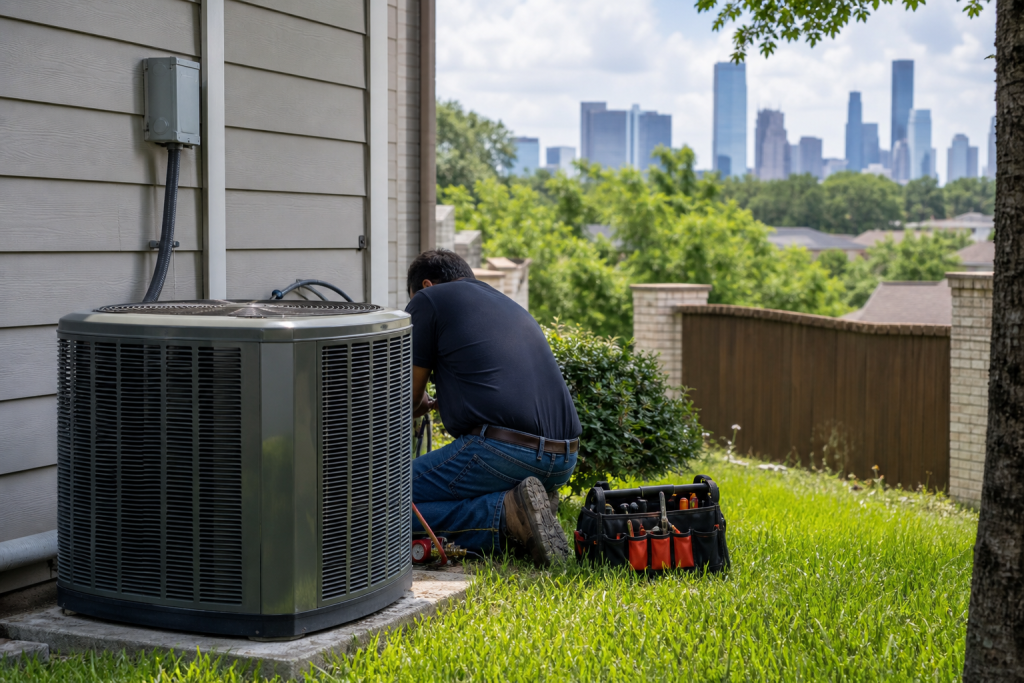
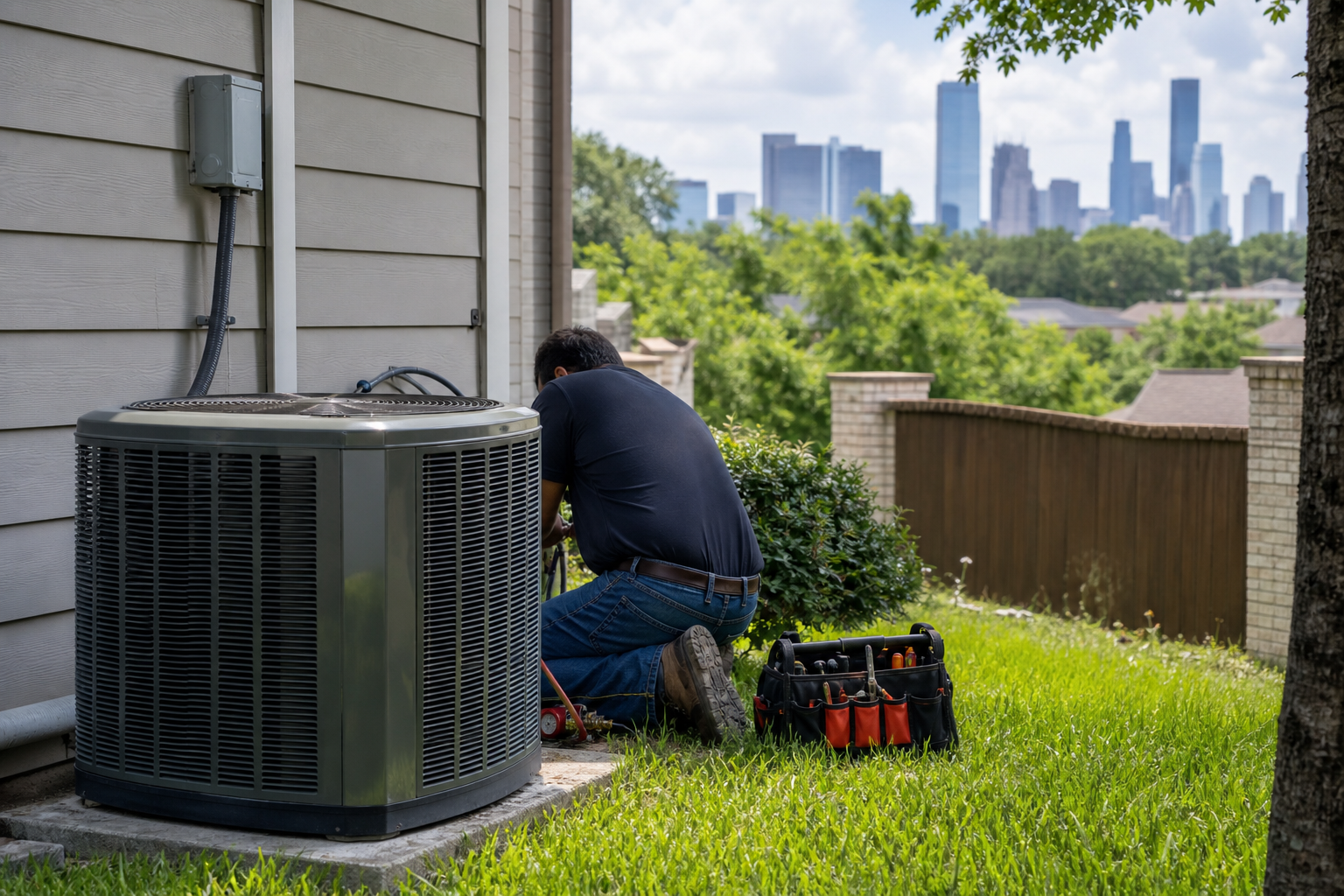
Emergency AC Repair & Installation Near Me: What Houston Homeowners Should Do First
When your AC fails in Houston during July or August, you have roughly thirty minutes to make decisions that will either save you hundreds or cost you thousands. Before calling any contractor, check your breaker, thermostat setting, drain line float switch, and filter - these four steps resolve about 15% of “emergency” calls without ever needing a technician. If those don’t restore cooling, call a company that answers with a live person, quotes upfront pricing, and sends background-checked technicians - in Houston, that description still narrows the field considerably.
If you’d rather skip the troubleshooting and talk to someone now, call Fireside Heating & Air Co. at (833) 313-7291. A live person answers, 24 hours a day, including the 2 a.m. calls.
Why Panic Calls in Houston Cost More Than Calm Ones
Houston’s heat index regularly exceeds 105°F, and a home without air conditioning becomes medically dangerous for elderly occupants in under four hours. That pressure creates a specific problem: the emergency AC call made in the first ten minutes of panic has a documented higher rate of unnecessary full-system replacement recommendations than calls made after a homeowner has done two basic checks themselves.
We’ve been serving Houston homeowners since 1984, and we’ve seen this pattern repeat every summer. The homeowner who calls at 2 p.m. with “nothing’s working, just come” often ends up with a $8,000-$12,000 replacement quote for a $400 capacitor failure. The homeowner who spends twelve minutes on our four-check protocol gets accurate diagnostics and honest options.
The difference isn’t intelligence. It’s heat stress and time pressure. Houston’s humidity makes indoor temperatures feel worse than the thermometer reads - your body can’t cool itself through evaporation. That physiological panic transfers directly to your wallet when the first contractor who answers the phone senses urgency and quotes accordingly.
Our recommendation: set a kitchen timer for thirty minutes. Do the checks below in order. If cooling doesn’t restore, you’ll call with better information and receive better service.
The Four Checks That Fix 15% of Houston “Emergencies” Without a Technician
These four checks take eight to twelve minutes total. They require no tools beyond a flashlight and possibly a wet/dry vacuum.
1. The breaker. Houston’s electrical grid strains under summer load. Your AC’s dedicated breaker - usually a double-pole switch in your main panel, labeled “AC,” “Condenser,” or “HVAC” - may have tripped without you noticing. Flip it fully off, then on. Wait three minutes before testing the system. If it trips again immediately, stop - that’s a legitimate electrical fault requiring professional diagnosis.
2. The thermostat setting. Check three things: the mode is set to “Cool,” the temperature setting is below current room temperature, and the fan is set to “Auto” (not “Off”). Programmable thermostats occasionally reset after power fluctuations common in Houston’s summer storm season. We’ve responded to emergency calls in Memorial and Bellaire where the thermostat had simply switched to “Heat” after a brief outage.
3. The drain line float switch. Houston’s humidity generates enormous condensate volume. When the primary drain line clogs - common in older homes in The Heights and Montrose where lines run flat or sag - a float switch shuts down the system to prevent water damage. Locate your indoor air handler (attic, closet, or garage), find the PVC drain line, and check for a small cylindrical or rectangular switch. If water has backed up, the switch is engaged. Clear the line with a wet/dry vacuum on the exterior outlet, or pour a cup of white vinegar through the access port. The system should restart within minutes once the water drops.
4. The filter. A filter clogged with Houston’s year-round pollen and fine dust can freeze the evaporator coil, triggering a safety shutdown. If your filter is gray or opaque when held to light, replace it. Wait thirty minutes for any ice to melt before restarting.
These four checks resolve a meaningful percentage of summer emergency calls. They’re also the diagnostic steps any honest technician would perform first - doing them yourself filters out contractors who charge $150 to flip a breaker.
How to Tell What’s Actually Broken Before You Call
If the four checks don’t restore cooling, you need to identify which component has failed. This matters because it lets you describe symptoms accurately, receive a realistic phone estimate, and recognize when a contractor is guessing.
Listen at the outdoor condenser. Is the fan spinning? Is the compressor humming? A silent unit suggests electrical failure or a bad capacitor - typically $200-$450 in Houston. A humming compressor that won’t start often indicates a hard-start kit or capacitor issue. A running compressor with no cold air suggests refrigerant loss or a failed compressor - the expensive one.
Check the indoor air handler. Is the blower running? Is air moving through vents, just warm? A running blower with warm air usually means the outdoor unit isn’t rejecting heat. No blower at all suggests a motor or control board failure - indoor work, different pricing.
Check for ice. Visible ice on the refrigerant lines or coil means restricted airflow or low refrigerant. Do not keep running the system - you’ll damage the compressor. Turn it off and call.
When you call with this information - “The outdoor unit’s humming but the fan won’t spin” - a competent dispatcher will narrow the likely failure and give you a realistic range. A company that quotes $89 “diagnostic” without asking what you’re seeing is planning to sell you something in your living room.
We train our technicians to ask these questions before dispatching. It saves Houston homeowners an unnecessary trip charge when the problem is actually a tripped breaker in the garage.
What Emergency AC Service Should Cost in Houston - And the One Question That Exposes Inflated Rates
After-hours and weekend emergency rates are legitimate. Technicians earn overtime, and companies schedule on-call rotations. But there’s a difference between fair overtime and exploitation of heat-stressed homeowners.
In the Houston market as of 2024-2025, expect these ranges for legitimate emergency service:
- After-hours diagnostic fee: $150-$250 (versus $75-$125 standard hours)
- Emergency repair labor: $150-$225 per hour (versus $100-$150 standard)
- Common same-day repairs (capacitor, contactor, float switch): $250-$550 total
- Refrigerant leak repair and recharge: $800-$1,800 depending on R-22 versus R-410A
The single question that separates fair pricing from inflated: “What is your total diagnostic plus repair rate if you fix it tonight, and do you cap that?”
Companies planning to exploit your urgency will deflect, quote only the diagnostic, or claim they “can’t know until they see it.” Honest operators have seen your failure before - capacitors fail the same way in Katy and Kingwood - and can give you a not-to-exceed range based on your description.
At Fireside, we quote upfront pricing on every job. The price we state is the price you pay. No “authorization to proceed” with blank checkboxes. No surprise line items discovered in your attic at 9 p.m.
The “Authorization to Proceed” Trap - Houston’s Most Expensive Heat-Emergency Mistake
Here’s a scenario we’ve encountered dozens of times in Houston summers: the technician arrives, diagnoses a failed capacitor, then presents a clipboard with an “authorization to proceed” form. The form authorizes “necessary repairs” up to a blank amount, or authorizes “replacement if repair not advisable.” The homeowner, sweating and anxious, signs. The “repair” becomes a $7,500 system replacement with financing paperwork.
This is legal if you signed. It’s also preventable.
Never sign an open-ended authorization. Insist on a written scope of work with specific parts, specific labor, and a fixed total before work begins. If the technician claims the full problem “can’t be known until we open it up,” that’s acceptable for complex diagnostics - but the authorization should cap at the diagnostic fee plus a stated maximum for the most likely repair.
Our AC Repair & Installation in Houston includes a written, itemized estimate before any repair begins. Our 90-Day Done Right Promise means if it’s not right, we make it right - in writing, no paperwork, no arguing. We’ve honored that promise since 1984.
If a technician pressures you to sign immediately because “parts are scarce in Houston,” or “this rate expires tonight,” that’s sales pressure, not technical necessity. Calmly decline. A legitimate emergency repair doesn’t evaporate in ten minutes.
Interim Cooling That Actually Works in Houston Humidity
While you wait for service - or if you’re assessing whether tonight can wait until morning - you need cooling strategies that work in Houston’s 70%+ relative humidity. Most online advice comes from dry-climate sources and fails here.
What works in Houston:
- Box fans in windows, blowing out, on the shaded side of the house. Creates negative pressure that pulls slightly cooler air from the ground floor. Effective from roughly 7 p.m. to 8 a.m. when outdoor temps drop below 80°F.
- Cold showers or damp sheets. Evaporative cooling fails in high humidity, but conductive cooling (contact with cold surfaces) still works. A damp sheet in front of a fan provides minimal relief - the water won’t evaporate fast enough. A cold shower, then resting on cotton sheets with a fan directly on skin, works better.
- Lowest floor of the house. Heat rises; Houston’s slab-on-grade construction keeps ground floors measurably cooler. Camp in the interior hallway or bathroom if upstairs bedrooms are uninhabitable.
- Window units or portable ACs. If you have one, run it in a single closed room. In Houston humidity, portable single-hose units are nearly useless - they draw in hot, humid replacement air. Window units or dual-hose portables are marginally effective.
What doesn’t work in Houston:
- Swamp coolers. These add humidity. Houston already has humidity. You’re making it worse.
- Opening all windows “for cross-breeze.” When outdoor dew points exceed 70°F, you’re importing wet heat faster than any breeze removes it.
- Ice in front of fans. The cooling effect is localized and temporary; the melted water adds humidity to the room.
For elderly or medically vulnerable occupants, don’t gamble. Houston’s combination of heat and humidity creates dangerous conditions faster than dry heat at the same temperature. A hotel room for one night costs less than an ER visit for heat exhaustion.
When to Call a Professional - And What to Expect
Call a technician when: the breaker won’t stay reset, you hear grinding or screeching from either unit, there’s visible refrigerant oil staining near the outdoor unit, or you’ve completed the four checks and the system still won’t cool after thirty minutes.
When you call Fireside at (833) 313-7291, a live person answers - not a voicemail tree, not an answering service reading a script. We’ll ask what you’ve checked, what you’re hearing, and how long the system’s been down. We’ll give you a realistic arrival window and a not-to-exceed range for the most likely repair. Our technicians arrive in uniform, put on shoe covers without being asked, and treat your home the way they would their own mother’s.
Related services in Houston: Heating & Furnace in Houston | Heat Pump & Mini Split in Houston
The Bottom Line
Houston’s summer heat demands respect, not panic. The thirty minutes after your AC fails are when expensive mistakes get made - signing blank authorizations, accepting replacement quotes for repairable systems, paying inflated “emergency” rates to companies that advertise 24/7 service but subcontract to whoever answers their after-hours line.
The protocol is simple: four checks, symptom identification, upfront pricing confirmation, written scope before authorization. These steps don’t require technical skill. They require the calm that comes from knowing what to do.
We’ve completed most AC repairs in Houston in a single visit since 1984. We’re trained on nine major brands including Carrier, Trane, and American Standard. Our 90-Day Done Right Promise means the job’s not done until it’s done right - and we put that in writing before we start.
If you’re in Houston and your AC has failed, call (833) 313-7291 for a free estimate. A live person will answer, day or night.
Frequently Asked Questions
Emergency AC repair in Houston typically ranges from $250 to $550 for common same-day fixes like capacitors, contactors, or float switches, with after-hours diagnostic fees of $150-$250. More complex repairs like refrigerant leak repair and recharge run $800-$1,800 depending on your system’s refrigerant type. Call (833) 313-7291 for an exact quote - estimates are free.
You can run it briefly to test, but don’t leave it running for hours. Warm air usually means the compressor isn’t working or refrigerant is low - continued operation risks overheating and permanently damaging the compressor, which turns a $400 repair into a $3,000+ replacement. Turn it off and call a technician.
For systems under ten years old, repair is almost always cheaper. For systems over fifteen years old with a major compressor or coil failure, replacement often makes better financial sense - especially with Houston’s long cooling season where efficiency matters. The critical factor is the repair cost versus replacement cost: if repair exceeds 40% of replacement and your system uses R-22 refrigerant, we recommend replacement. We give straight talk about repair versus replace on every call.
Reputable Houston HVAC companies typically arrive within 2-4 hours for true emergencies during business hours, and 2-6 hours after hours depending on location and call volume. Same-day service is standard for most of Houston; same-hour service is rare and often carries premium pricing that may not be justified. At Fireside, we answer every call with a live person and give you a real arrival window we intend to keep - not a callback tomorrow morning.
Written by the team at Fireside Heating & Air Co. of Houston, serving Houston since 2011.
Need HVAC Help?
Call Fireside Heating & Air Co. of Houston - licensed & insured, here with fast after-hours help in Houston.
(833) 313-7291