
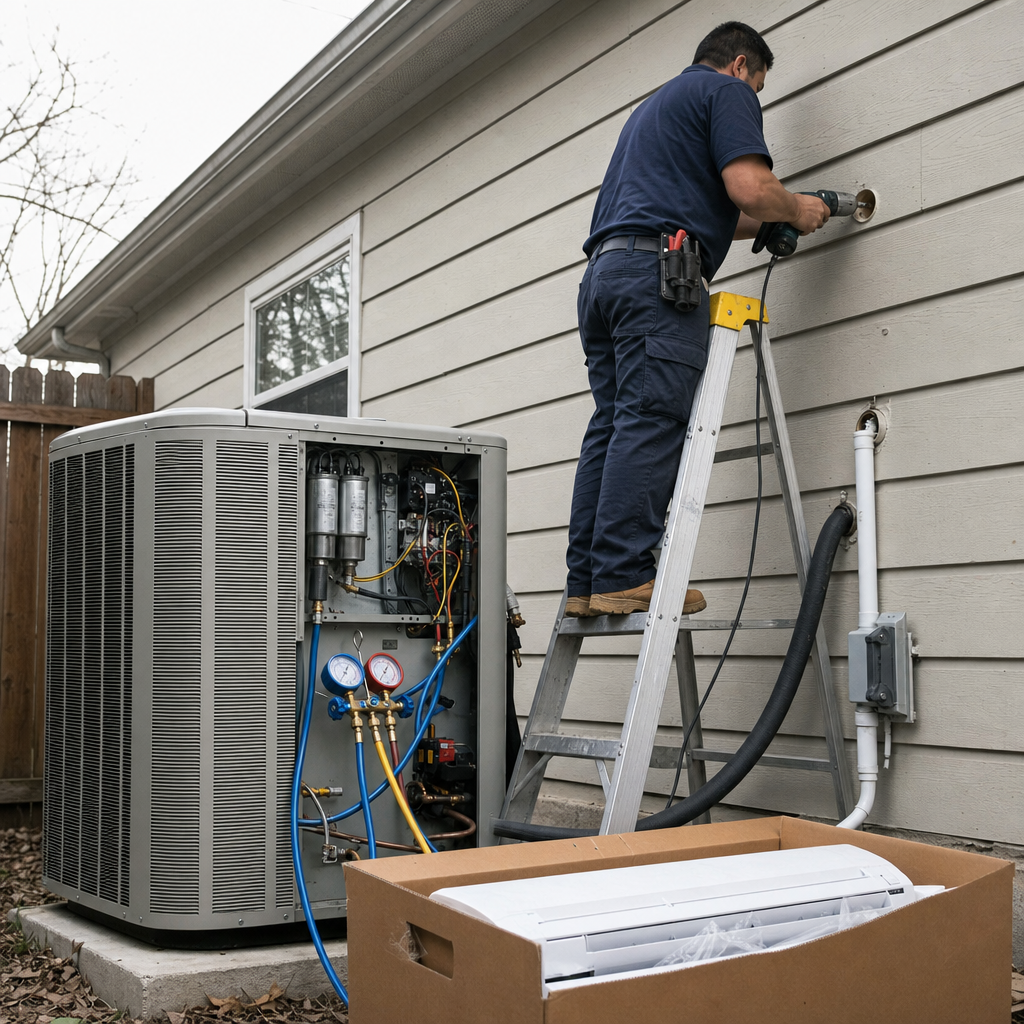
Goodman Capacitor Replacement: The Houston Owner’s Guide
We stock and install Goodman-compatible start and run capacitors for every residential series, with most replacements completed same-day for $150-$340 installed. In Houston’s heat, capacitors work harder than just about any other electrical component in your condenser, and when they fail, the compressor either won’t start or won’t stay running. Homeowners usually notice the problem on the first ninety-degree afternoon, when the house won’t cool down and the outdoor unit hums without the fan spinning or the compressor kicking in.
Which Goodman Models This Applies To
Goodman has used several capacitor configurations across their residential lines, and matching the right one matters. The GSX13, GSX14, GSX16, and GSXC18 single-stage condensers typically carry a dual run capacitor, usually 35/5 µF or 45/5 µF at 370 or 440 VAC. The higher-efficiency DSXC16 and DSXC18 two-stage units, along with the GVXC20 variable-capacity line, often require a larger dual run capacitor, sometimes 50/7.5 µF or 55/7.5 µF, also at 440 VAC. The label on your existing capacitor, mounted on the side of the round or oval can, lists the microfarad rating, voltage, and whether it’s a dual-run (three terminals: Herm, Fan, Common) or a separate start capacitor with a potential relay.
We carry both OEM Goodman-branded capacitors from Daikin, Goodman’s parent company, and quality aftermarket equivalents from Titan Pro and Genteq that meet or exceed the same EIA-456-A standard. For most Houston homeowners, the aftermarket option saves twenty to forty dollars with no meaningful difference in lifespan. The exception is the GVXC20 with its inverter-driven compressor, where we prefer OEM to avoid any mismatch with the variable-frequency drive. If your unit is still under the ten-year parts warranty, we’ll note the serial number and help you determine whether Goodman owes you the part at no charge, though you’ll still pay for the labor to install it.
One compatibility gotcha we see regularly: Goodman switched from 370 VAC to 440 VAC ratings on many models around 2010. A 440 VAC capacitor will safely replace a 370, but never the reverse. The physical size also varies, oval versus round, and the mounting strap has to fit. We measure before we quote.
Fireside Heating & Air Co. of Houston is an independent service provider, not affiliated with Goodman Manufacturing or Daikin.
Signs Your Goodman Capacitor Replacement Is Failing
- Humming outdoor unit, no compressor start. The capacitor’s job is to deliver a high-voltage jolt to get the compressor motor turning. When the capacitance drops below 10% of rating, that jolt weakens. The compressor sits there, hot and humming, until the thermal overload shuts it down. In Houston, we see this most in August when the unit has been cycling all day.
- Fan spins slowly or not at all, but compressor runs. The fan side of a dual-run capacitor can fail independently of the compressor side. The fan motor gets reduced voltage, turns sluggishly or not at all, and the compressor overheats from lack of airflow across the coils.
- Intermittent cooling, especially after the unit sits idle. A weak capacitor may start the compressor on cooler mornings or after a long rest, then fail on the next cycle when the component is already heat-soaked. Houston’s overnight lows in July barely dip below eighty, so the capacitor never really cools off.
- Bulging or leaking capacitor can. The top of the capacitor dome should be flat. Heat and age cause the electrolytic material inside to expand, creating a dome or even splitting the seal. Oil residue around the base is a sure sign. We’ve pulled capacitors in Third Ward and Spring Branch that looked like they were about to burst.
- System blows warm air, then cools, then warms again. This cycling pattern often means the capacitor is delivering just enough to start the compressor sometimes, but not reliably. The homeowner cranks the thermostat lower, stressing the part further until it fails completely.
Replacement Cost & What’s Included
Goodman capacitor replacement in Houston runs $150-$340 installed, with most jobs falling between $180 and $260. The part itself accounts for $35-$85 depending on whether you choose OEM or quality aftermarket, and whether it’s a standard dual-run or the larger capacitor for a two-stage or variable-capacity unit. The remainder covers diagnostic time, safe discharge and removal, installation, testing of compressor and fan amp draw, and verification that the system holds proper pressures.
What moves the price: accessibility of the outdoor unit, whether the capacitor has leaked and corroded the contactor or wiring, and if we find a secondary issue like a failing hard-start kit or weak compressor. We quote one price before any work begins, and that’s the price you pay. The 90-Day Done Right Promise covers the labor, and the capacitor itself carries a manufacturer’s warranty, five years on most aftermarket, ten years on OEM when registered.
Every repair over $250 qualifies for our $50 discount. Seniors and veterans receive 5% off, always.
DIY or Call Us?
There’s a honest split here, and we’ll give it to you straight. A homeowner can safely check whether the capacitor is bulging or leaking with the power off at the disconnect, and can read the label to know what part to order. That’s about where safe DIY ends.
Capacitors store a lethal electrical charge even with the power disconnected. A 440 VAC capacitor can deliver a shock that stops your heart, and the discharge procedure requires bridging the terminals with an insulated resistor, not just a screwdriver across the pins. We’ve been called to homes in Acres Homes and the Heights where a well-meaning homeowner shorted the terminals, blew the fuse, and still got knocked across the patio. Beyond the safety issue, compressor and fan amp draw need testing after installation, a weak compressor will kill the new capacitor within weeks, and the wrong µF rating will overheat the motor it was meant to protect.
We’re not saying this to drum up business. We’re saying it because Randall Becker learned early in this trade that some jobs aren’t worth a trip to the emergency room. If you’re comfortable with a multimeter and understand locked-rotor amperage, you already know your limits. If you’re not, call us at (833) 313-7291. We’ll be there when we say, and the price quoted is the price paid.
FAQs
How long does a Goodman capacitor last in Houston?
In Houston’s climate, expect five to ten years, with most failing around seven. The combination of heat, humidity, and near-constant summer cycling degrades the dielectric material faster than in cooler markets. Units with poor airflow from dirty coils or overgrown landscaping fail sooner. Call (833) 313-7291 if yours is over six years old and acting up, estimates are free.
Can a failing capacitor be repaired instead of replaced?
No. Capacitors are sealed, non-serviceable components. Once the internal electrolyte degrades or the plates short, replacement is the only fix. Some companies sell “reconditioned” capacitors, we don’t recommend them, the savings are minimal and the failure rate is high. We only install new, factory-fresh parts with a verifiable date code.
How long does the replacement take?
Most Goodman capacitor replacements take thirty to sixty minutes from arrival to tested and running. We carry the common sizes on every truck, so there’s no waiting on a parts run. If we find corroded wiring or a failing contactor, we may need an additional thirty minutes, but we’ll tell you before we start. Same-day service is standard, not an upcharge.
Do you stock Goodman capacitors, or do you have to order them?
We stock dual-run and start capacitors for every Goodman residential series from the GSX13 through the GVXC20, in both 370 and 440 VAC ratings, oval and round cases. The only time we order is for an unusual aftermarket modification or a unit that’s been converted to a different configuration. For standard Goodman systems, we have it on the truck. Call (833) 313-7291 to confirm same-day availability for your model.
Written by Randall Becker, Owner & Lead Technician, Fireside Heating & Air Co. of Houston at Fireside Heating & Air Co. of Houston, serving Houston and nearby areas.